


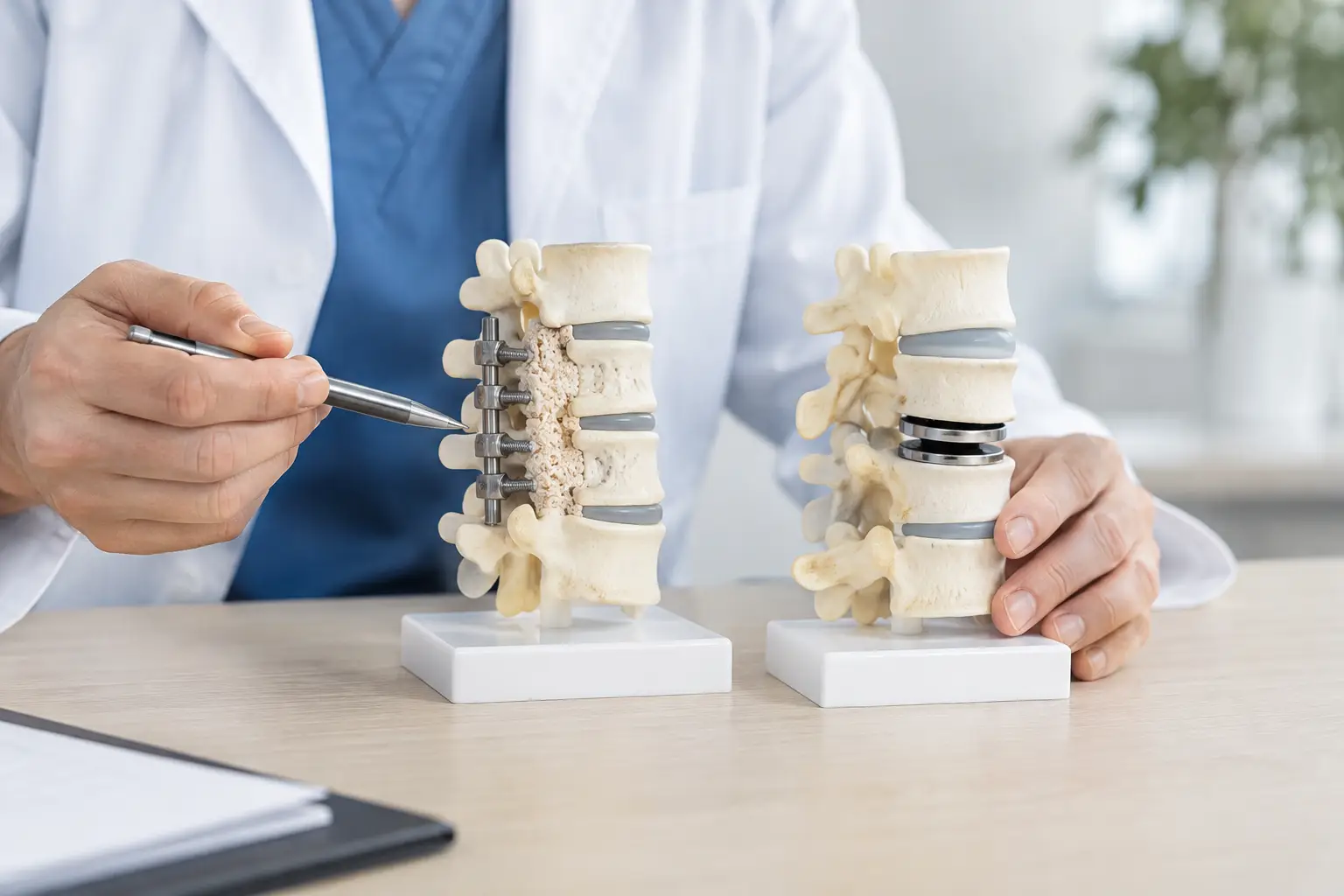
A recommendation for spine surgery should never begin with a procedure name. It should begin with the source of your pain, numbness, weakness, or loss of function. In the discussion of fusion versus replacement, the right choice depends on far more than which operation sounds less invasive or promises more motion. It depends on the condition of the disc, the stability of the spine, the health of nearby joints, your symptoms, and the treatment goal.
For some patients, spinal fusion is the most reliable way to stabilize a painful or unstable spinal segment. For others, artificial disc replacement may preserve motion while relieving pressure on nerves. Neither procedure is automatically better. A thorough evaluation helps determine whether either surgery is appropriate and, if so, which approach offers the clearest path forward.
What spinal fusion is designed to do
Spinal fusion joins two or more vertebrae so they heal into one stable unit. During the procedure, a surgeon may remove a damaged disc, relieve pressure on the spinal cord or nerves, place bone graft material, and use implants such as screws, rods, or a cage to hold the area in proper alignment while fusion occurs.
The purpose is stability. A fusion may be recommended when a spinal level moves abnormally, has collapsed significantly, is out of alignment, or cannot support a motion-preserving implant safely. It is commonly used for conditions such as spondylolisthesis, advanced degenerative disc disease, spinal deformity, recurrent disc problems, fractures, instability after decompression, and some cases of failed prior surgery.
Fusion does reduce motion at the treated level. For many patients, that trade-off is worthwhile because the painful movement or instability is precisely what needs to be addressed. The neck and low back contain multiple motion segments, so a single-level fusion does not necessarily prevent a patient from returning to normal daily movement. Recovery and final function, however, depend on the number of levels treated, the underlying diagnosis, bone quality, overall health, and the demands of work or recreation.
What artificial disc replacement is designed to do
Artificial disc replacement, also called disc arthroplasty, removes a diseased spinal disc and replaces it with a mechanical implant intended to preserve movement at that level. The procedure is most established in the cervical spine, or neck. Lumbar disc replacement can be appropriate in carefully selected cases, but eligibility is more limited and requires detailed evaluation.
Like fusion, disc replacement may relieve nerve compression caused by a herniated disc or disc degeneration. The key difference is that replacement is designed to maintain controlled motion rather than eliminate it. That can be appealing to patients who are active or concerned about preserving flexibility.
Still, preserved motion is not the same as a normal, untouched disc. An artificial disc has specific indications and technical requirements. It must be placed in a spinal segment with enough stability and healthy supporting structures to function as intended. If the segment is already unstable, severely arthritic, deformed, or compromised by poor bone quality, replacement may create more risk than benefit.
Fusion versus replacement: the factors that matter most
The decision is not simply a choice between an older operation and a newer one. It is a clinical question: what does this particular spine need?
The condition of the facet joints
Facet joints are small joints at the back of the spine that help guide movement. When they are significantly arthritic, preserving motion at a damaged disc level may continue to provoke pain. In that situation, fusion may be more appropriate than disc replacement because it stabilizes both the disc space and the painful motion segment.
Spinal stability and alignment
Disc replacement generally requires a stable, well-aligned segment. Marked spondylolisthesis, scoliosis, kyphosis, excessive movement on flexion-extension X-rays, or major collapse can make fusion the safer option. Fusion can also help restore alignment when the disc space has narrowed or the spine has shifted.
Bone quality
An implant needs secure support from the vertebral bone. Osteoporosis or poor bone density may affect candidacy for either procedure, but it is particularly relevant when considering a motion-preserving device. Bone health, medications, nutrition, smoking status, and medical history should be part of surgical planning.
The number of levels involved
A single disc causing symptoms is different from widespread degeneration across several levels. Some patients may be candidates for multilevel fusion, multilevel disc replacement, or a hybrid procedure that combines replacement at one level with fusion at another. The best approach is based on the pathology at each individual level, not a one-size-fits-all rule.
Prior surgery and scar tissue
Previous surgery does not automatically rule out future treatment, but it can change the options. Recurrent symptoms after a prior fusion, decompression, or disc procedure require a careful review of operative reports, imaging, alignment, and the likely source of pain. A second opinion can be especially valuable when a revision surgery has been recommended.
How symptoms and imaging guide the decision
MRI, CT, X-rays, and physical examination each answer different questions. An MRI can show disc herniation, spinal stenosis, nerve compression, and spinal cord pressure. Dynamic X-rays can reveal instability that may not be visible on an MRI performed while lying down. CT imaging may clarify bone anatomy, prior fusion healing, or arthritic changes.
Equally important is whether the findings match your symptoms. A disc bulge on a scan does not always explain pain. A surgeon should identify the relationship between imaging findings and issues such as arm pain, leg pain, weakness, numbness, balance problems, difficulty walking, or loss of hand function.
Surgery is generally considered after appropriate nonsurgical care has not provided adequate relief, or sooner when there is progressive neurologic weakness, spinal cord compression, significant instability, or another urgent structural concern. Physical therapy, targeted injections, medication management, activity modification, and other conservative measures may remain the right choice for many patients.
Recovery: meaningful differences, shared responsibilities
Recovery timelines vary considerably. Disc replacement may allow earlier motion at the treated segment, while fusion requires time for bone healing. That does not mean replacement is always an easier recovery or that fusion always means prolonged disability. The extent of surgery, surgical approach, overall health, job requirements, and adherence to postoperative instructions all matter.
After either procedure, patients commonly follow restrictions on lifting, bending, driving, and certain activities for a defined period. Follow-up visits and imaging help the surgical team monitor healing, implant position, alignment, and neurologic recovery. Smoking cessation is particularly important for fusion because nicotine can interfere with bone healing. Maintaining a healthy weight, controlling diabetes, and following rehabilitation guidance can support safer recovery after either operation.
Pain relief may also occur on different timelines. Nerve irritation that has been present for months or years may improve gradually, even when pressure on the nerve has been successfully relieved. Surgery aims to treat a defined structural problem. It cannot guarantee that every source of pain, stiffness, or weakness will resolve.
Risks should be discussed clearly
Every spine procedure carries potential risks, including infection, bleeding, blood clots, anesthesia complications, nerve injury, spinal fluid leak, persistent symptoms, and the need for additional treatment. The specific risk profile differs by procedure and by spinal region.
With fusion, concerns can include failure of the bones to heal fully, hardware-related issues, and stress changes at levels above or below the fusion over time. With disc replacement, concerns include implant wear or migration, unwanted bone formation around the implant, persistent pain from untreated facet arthritis, and the possibility that a later revision could be needed.
These risks should be placed in context, not used to create unnecessary fear. An experienced spine surgeon can explain which risks are most relevant to your anatomy, diagnosis, medical history, and proposed operation.
Questions to bring to a spine consultation
A focused conversation can make a complex decision easier to understand. Consider asking:
- What is the specific structural cause of my symptoms?
- Am I a candidate for disc replacement, fusion, or continued nonsurgical treatment?
- What findings make one procedure more appropriate for me?
- How many spinal levels require treatment, and why?
- What restrictions, recovery milestones, and realistic outcomes should I expect?
At Total Spine & Brain Institute, surgical recommendations are based on a detailed review of symptoms, neurologic findings, imaging, and prior treatment. For patients facing a major decision, that level of diagnostic clarity matters.
The most useful question is not, “Which procedure is best?” It is, “Which treatment best addresses the actual problem in my spine while protecting my long-term function?” A careful specialist evaluation can provide an answer grounded in your anatomy, your goals, and the treatment options that truly fit.
